
Power Supplies for Medical Equipment, Applications and Regulation – MEAN WELL
Power supplies for the medical field are chosen according to the application requirements and purpose of the medical product. Therefore, it is necessary to consider the safety of patients and medical equipment operators. The basic assumption is that there is no room for failures that could cause injury and/or, God forbid, death to any person involved in operating the medical device.
Considering these parameters requires medical standards, and therefore medical power supplies contain protective components that meet the above requirements. Naturally, the cost of a medical power supply is higher than any industrial power supply. Here are the main parameters that must be present in medical power supplies:
Isolation
Isolation is one of the most important parameters in defining a medical power supply. The isolation issue defines the isolation between the input and output of the power supply, where the input is AC voltage and the output is DC voltage.
In the medical field, regulations are divided into two main groups: "MoPP" and/or "MoOP".
Mean of Patient Protection (MoPP) refers to the isolation required for the patient who is connected to the medical equipment.
Mean of Operator Protection (MoOP) refers to the isolation required for the operator who operates the machine (medical equipment).
Within these two groups, there is a further secondary division into "low" and/or "high" protection.
This division, of course, depends on the application of the medical device and the standards it needs to meet.
The most updated regulatory standard addressing these requirements is IEC 60601-1 4th Edition
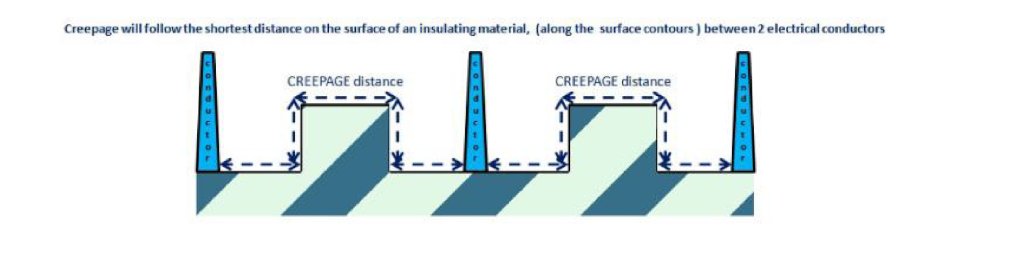
The degrees are measured by the distances of the following factors:
Clearance – The shortest air distance between electrical conductors.


Isolation is a term referring to the resistance of electricity transfer between the "primary" and "secondary" coils. Isolation can be basic or double isolation for maximum protection.

Medical power supplies, if the input voltage is AC, can come in two configurations: grounded power supplies with a three-pin input (phase, neutral, and ground) or ungrounded supplies with only two pins (phase and neutral).
In the figure on the left, a power supply with grounding is shown – it is called a Class I power supply.
In the figure on the right, a power supply without grounding is shown – it is called a Class II power supply.

Leakage Current
Leakage current is defined as the current "leaking" between the input and ground. The larger the input capacitors in terms of capacitance, the greater the leakage current will be, and this, of course, affects the filtering of the power supply from the other direction.
There is a difference between the American and European standards:
The American standard UL60601 allows a leakage current of up to 300uA.
The European standard EN60601 allows a leakage current of up to 500uA.
The following figure illustrates how a leakage test is performed:

Fuses
A fuse is mandatory in every power supply and must be placed on the hot line, i.e., on the input phase.
In a portable medical device or system, fuses must be placed on both the hot line (Phase) and the Neutral line. All MEAN WELL medical power supplies are equipped with two fuses.
As part of defining a medical power supply, it is important to define and understand how the equipment connects to the patient or is operated by the caregiver. The following terms refer to parts of medical equipment that come into contact with the patient:
- B)Body)
- BF)Body Floating)
- CF)Cardiac Floating)
The term B)BODY) defines medical equipment that does not involve direct patient contact, and therefore its requirements are the lowest in severity. 
The term BF)Body Floating) defines medical equipment that, in some applications, involves direct patient connection and contact, and provides electrical signals or electro-physical energy to the patient. For this definition, the power supply must comply with BF.

The term CF)Cardiac Floating) defines medical equipment that involves invasive contact with the patient's body.
Some applications are suitable for cardiac treatments. This application will accompany every power supply with CF APPLIED certification.

The power supply must, of course, technically meet all requirements. However, another important point is the cost of the power supply. Therefore, even after finding the suitable power supply, its cost must be evaluated against the target price set to ensure the successful sale of the medical product in the local and global markets.
Shlomo Ostrovsky, VP Sales, Advice Electronics
Rami Manoach, Application Engineer, Advice Electronics